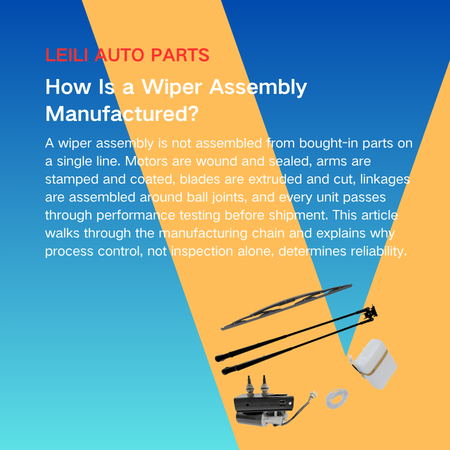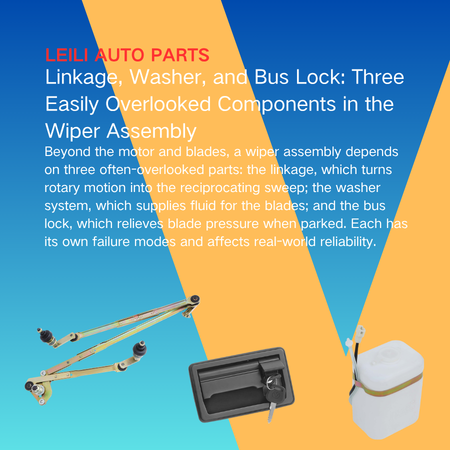



Wiper linkage: turning motor rotation into reciprocating sweep
What does the wiper linkage do?
The motor outputs rotary motion. The blade needs to swing back and forth across a fan-shaped area. The linkage performs that conversion.
The motor output shaft drives a crank; the crank’s end connects to the linkage rods through ball joints. As the crank rotates, the rods are pushed and pulled back and forth, and the rods drive the wiper arms through their pivots. Multiple linkages connected in series make the left and right arms sweep together at the designed angle and phase.
Key design points
Ball joint sealing and lubrication. This is the most vulnerable point of the linkage. The ball joints must stay flexible through millions of reciprocating cycles while keeping rain and dust out. Once a seal fails and water enters, corrosion raises the joint’s rotational resistance — and the driver feels it as uneven wiping speed and jerky swings. In severe cases the joint seizes.
Rod rigidity. The rods carry alternating push-pull loads. A rod without enough rigidity deforms elastically under load, so the blade’s actual sweep angle drifts from the design value — the visible result is unwiped strips at the edges of the glass.
Installation positioning. The linkage’s mounting position sets the sweep range and the park position. An angular deviation at assembly shows up directly as a blade that never reaches its intended position, or one that sweeps past the edge of the glass.
(How these parameters are controlled in production is covered in the wiper assembly manufacturing process guide.)
Common fault symptoms and root causes
Symptom | Most likely root cause | Component at fault |
Uneven wiper speed or mid-sweep pauses | Corroded ball joint from failed seal | Linkage ball joints |
Left and right wipers out of sync — overlap or collision | Linkage phase angle out of position | Linkage installation |
Reduced sweep range, edges not wiped | Rod elastic deformation under load, or pivot wear | Linkage rods |
Clunking noise during operation | Excess clearance in ball joint or worn bushing | Linkage joints |
Blade stops short of park position | Mounting angular deviation | Linkage installation |

wiper linkage assembly for commercial vehicles
Windshield washer system: why wiping fails without it
What does the washer system do?
The job sounds trivial: spray cleaning fluid onto the windshield before the blades pass over it.
It is the most underestimated step in the whole system. A blade wiping dry glass does not clean — it drags. Friction rises sharply, which accelerates blade wear, loads the motor, and smears oil film and insect remains across the glass instead of removing them. In actual use the washer and the wipers are one matched pair, not two independent systems.
How it works
The system consists of a reservoir, a washer pump, tubing, and nozzles. When the driver presses the washer switch, the pump draws fluid from the reservoir and pushes it through the tubing to the nozzles, which spray it onto the target zones of the glass — zones chosen to land inside the blade’s sweep area.
Key design points
Spray position and angle. Nozzle mounting position and spray angle must match the blade’s sweep area. Spray too high and airflow carries the fluid off the glass before the blade arrives; too low and the upper part of the glass never gets wet during the wipe. Windshield curvature and wiper layout differ across vehicle models, so the nozzle angle must be tuned per model — this is why “universal” nozzle settings underperform.
Anti-freeze performance. In cold regions, residual fluid in the tubing and nozzles freezes, blocking spray and in bad cases cracking components. Both the fluid formulation and the tubing layout (short runs, drainage-friendly routing) need to be designed for the target climate.
Filtration and anti-clogging. Nozzle orifices are very small, and impurities or scale in the fluid clog them easily. The symptom is reduced spray volume, or one nozzle spraying weak or off-target. The reservoir inlet carries a filter screen — an easily overlooked maintenance point that prevents most of these complaints.
Common fault symptoms and root causes
Symptom | Most likely root cause | Component at fault |
Reduced spray volume or weak spray | Clogged filter screen or scale in lines | Reservoir filter / tubing |
One nozzle not spraying or spraying off-target | Clogged nozzle orifice, or knocked-out-of-angle nozzle | Nozzle |
No response when switch is pressed | Pump failure or wiring issue | Washer pump / harness |
No spray in winter, spray returns when warm | Frozen residual fluid | Tubing layout / fluid grade |
Blades wear fast and glass streaks even when “working” | Nozzles spraying outside the sweep area — blades wiping mostly dry | Nozzle angle setup |
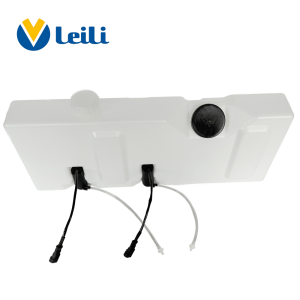
XD-B10L Wiper Washer
Bus door lock: protection in the parked state
What does the bus door lock do?
The bus door lock is the latching and locking mechanism for the driver’s door — and on many bus models, for the passenger doors as well. It decides whether a bus that is parked, standing at a stop, or running on rough roads keeps its doors securely closed.
The name makes it sound trivial. It is not. A bus door operates hundreds of times a day across years of service, in rain, dust, road salt, and — on many routes — freezing temperatures. The lock must latch positively every single time, hold against vibration and wind pressure while driving, and keep the vehicle secure through long parked hours.
Key design points
Locking reliability. Once latched, the mechanism must hold against driving vibration, door slam loads, and wind without releasing on its own. This comes down to the latch’s self-locking geometry, the strength of its materials, and the precision of its fit — not to spring force alone.
Ease of operation. Drivers and conductors operate the lock many times a day, every day. An over-stiff or over-complicated mechanism discourages proper use — a door that is “difficult to close properly” ends up being slammed, or not fully latched at all. A simple, reliable structure beats a clever one.
Sealing and corrosion resistance. The lock sits at the door edge, fully exposed to washing water, road spray, and salt. Corrosion inside the latch is the main reason locks go stiff and eventually seize. Surface treatment and drainage-friendly design matter more here than raw strength.
Cold-climate adaptation. In freezing regions, water that enters the latch or the lock cylinder turns to ice, and a lock that worked perfectly in autumn refuses the key in January. Drainage paths, low-temperature lubricant, and corrosion-resistant surface treatment are what keep the mechanism working through winter.
Common fault symptoms and root causes
Symptom | Most likely root cause | Component at fault |
Door rattles or pops open on rough roads | Latch wear or self-lock geometry compromised | Lock latch |
Door hard to close, lock feels stiff | Corrosion inside the latch, or cable/linkage stiffness | Lock mechanism |
Lock refuses the key or freezes in winter | Water ingress and ice inside the cylinder | Sealing / drainage |
Door does not align with the striker | Mounting deformation or worn striker | Installation |
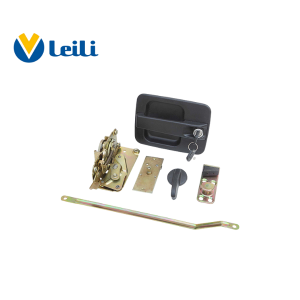
LL-115 driver door lock for bus cab door, latch mechanism with mounting bracket