



In brief
This fitment guide explains the five common commercial-vehicle wiper layouts: overlapping opposing, vertical opposing, integral parallel, split parallel, and one-drive-one. Which layout fits depends on windshield geometry, how the arms park, the space behind the cowl, the sweep coverage the driver needs, and how the motor and linkage share the load. The comparison table states when better coverage applies—for example on a wide, low screen versus a tall glass that must track an A-pillar—rather than treating any layout as universally better. Use the diagrams and Quick-Check as a starting filter. Confirm the final layout on a drawing and, where needed, a sample wipe test.
What the wiper layout decides before you buy
Choose the layout before you choose a motor rating. The windshield geometry decides how the arms must move. Motor power, blade length and a catalogue photograph come after that plan is clear.
Layout choice is a fitment decision. It depends on a short list of conditions, not on a vehicle badge or a preferred catalogue name.
- Windshield geometry: width, height, curvature and how upright the glass is.
- Park direction: arms that mirror from the two lower corners, both lie the same way, or a single arm on one pane.
- Installation space behind the cowl: room for one continuous linkage, two smaller modules, or a single motor and arm.
- Sweep coverage the driver actually needs: the centre of a wide screen, a tall edge or A-pillar, or one defined pane.
- How the motor and linkage share the load: one motor for two arms, or one motor per arm.
The layout is the plan for how many arms you use, where they park, and how they move across the glass. It is not a motor rating, a blade length or a product photo.
A poor match leaves a dry patch in the driver’s forward view, parks an arm in the sight line, or overloads a motor that was never the real problem. Two buses of the same length can still need different layouts, because the glass, pivot pockets and park trough differ.
Once the layout family is clear, review complete assemblies, motors and arms as parts of that plan, not as substitutes for it. Assemblies are listed at https://www.leiliautoparts.com/wiper-assembly-manufacturer/ . Motors are listed at https://www.leiliautoparts.com/wiper-motor-manufacturer/ , and arms at https://www.leiliautoparts.com/wiper-arm-manufacturer/ .
The five layouts, and how each one moves
Commercial buses and many construction cabs use five recurring plans. The names below match how many Asian OEM catalogues describe them. Overseas buyers often use different words for the same motion; those aliases appear in the next section.
Each diagram is a teaching sketch of the windshield, the arms and the sweep path. It is not a production drawing.
Overlapping opposing
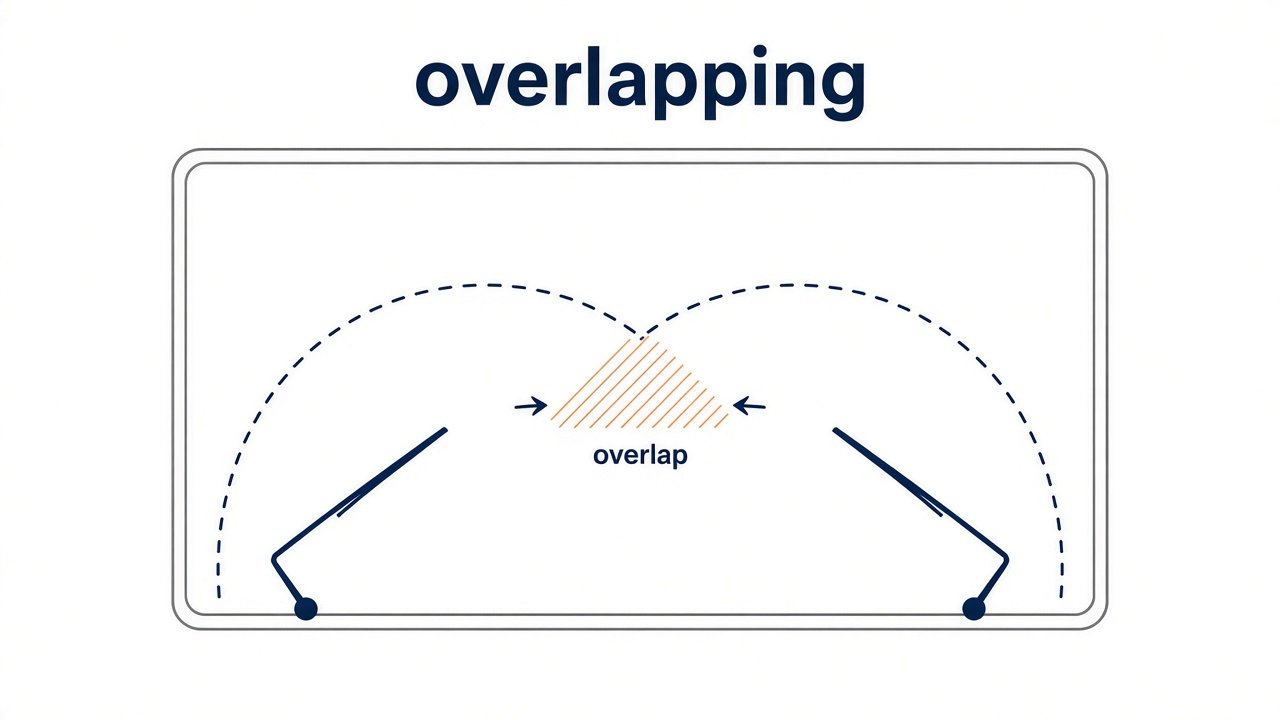
Two opposed pendulum arms sweep inward; the hatched zone is the overlap that reduces a centre dry patch.
This is the common plan on a wide, fairly upright windshield. Each arm swings from its own lower corner toward the centre. The two arcs overlap so the middle of the driver’s view is wiped twice rather than left dry.
Use it when the glass is much wider than it is tall and the parked arms mirror each other from the two bottom corners.
The trade-off is linkage complexity. Check the overlap zone, park angle and washer-jet aim so the arms do not collide at the centre. Bus and coach assemblies in this family are shown on https://www.leiliautoparts.com/bus-coach-windshield-wiper-system/ .
Vertical opposing
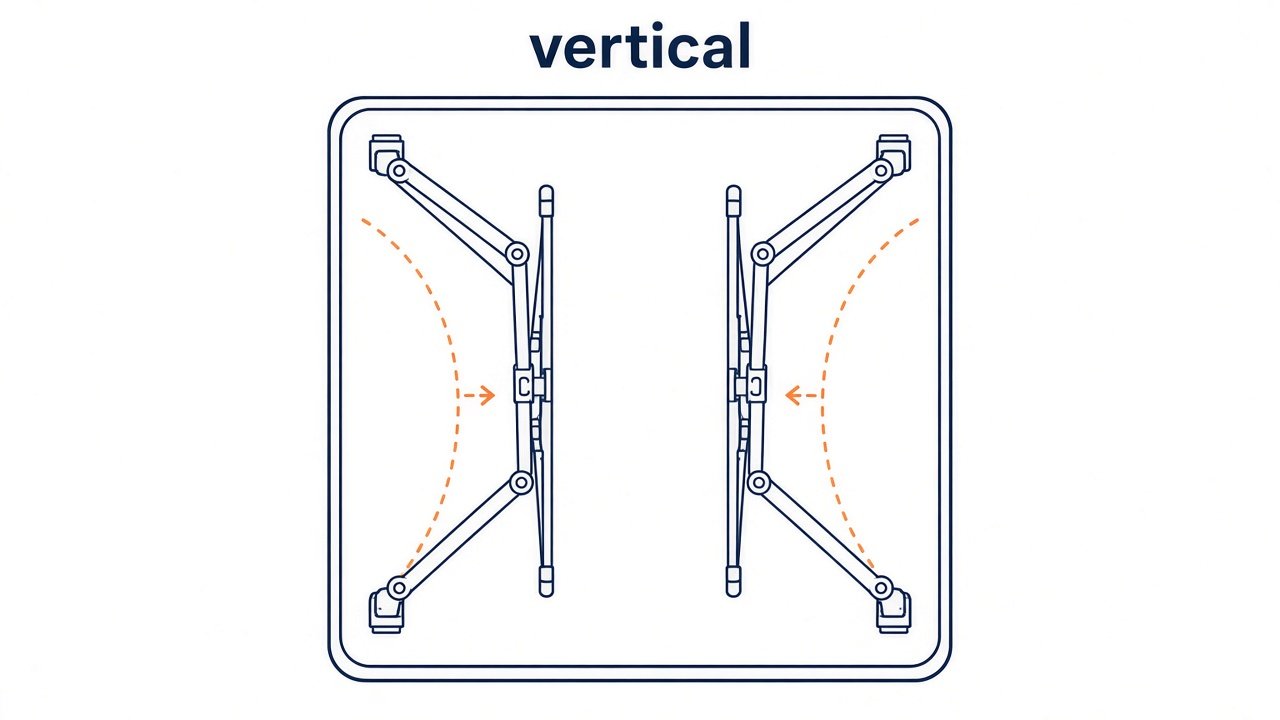
Upright or pantograph-style arms keep the blade more parallel to a tall glass edge while still sweeping toward the centre.
Choose this when the screen is tall, or when a simple pendulum blade would leave a dry strip along an A-pillar or the upper corners.
The blade stays more parallel to the vertical edge through the stroke. That usually means extra links in the arm, often called a pantograph or parallel-motion arm.
A quick visual cue: watch the rubber, not the brochure word. If it stays roughly upright as it travels, you are looking at vertical or pantograph geometry. If it simply fans from one pivot, that is a pendulum arm. Review arm geometry on https://www.leiliautoparts.com/wiper-arm-manufacturer/ together with the opposed layout, not as a separate guess at motor power.
Integral parallel
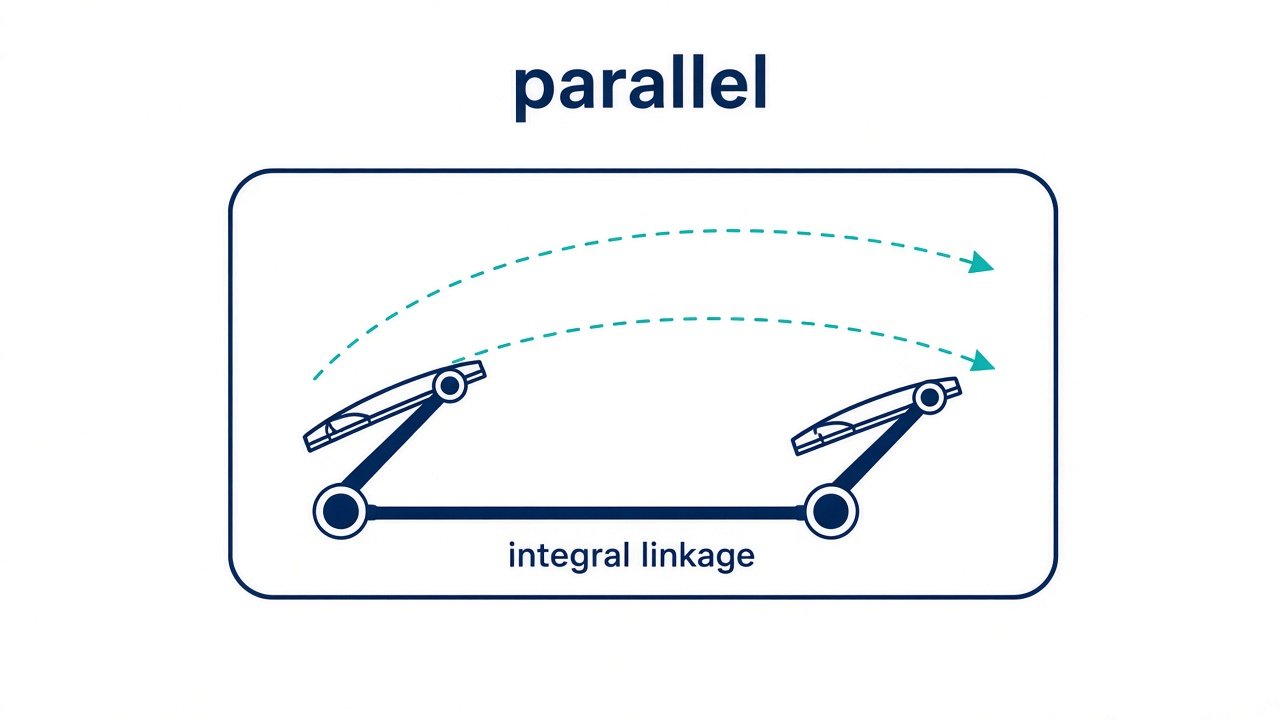
Both arms travel in the same direction, driven through one continuous (integral) linkage between the two pivots.
Both blades park on the same side and sweep across the glass together, like many passenger-car systems, but scaled for a commercial windshield.
The two pivots share one connecting bar or stamping. That package is often simpler to mount when the cowl can accept a single module.
It is a poor fit when the glass is very wide and a same-direction pair would leave a dry triangle in the centre of the driver’s view. In that case, review an overlapping plan instead.
Some catalogues label parallel assemblies as ordered. That is a product-family name, not a shipping term. Confirm from the mounting side that the bar is continuous; linkage forms are illustrated at https://www.leiliautoparts.com/wiper-linkage-manufacturer/ .
Split parallel
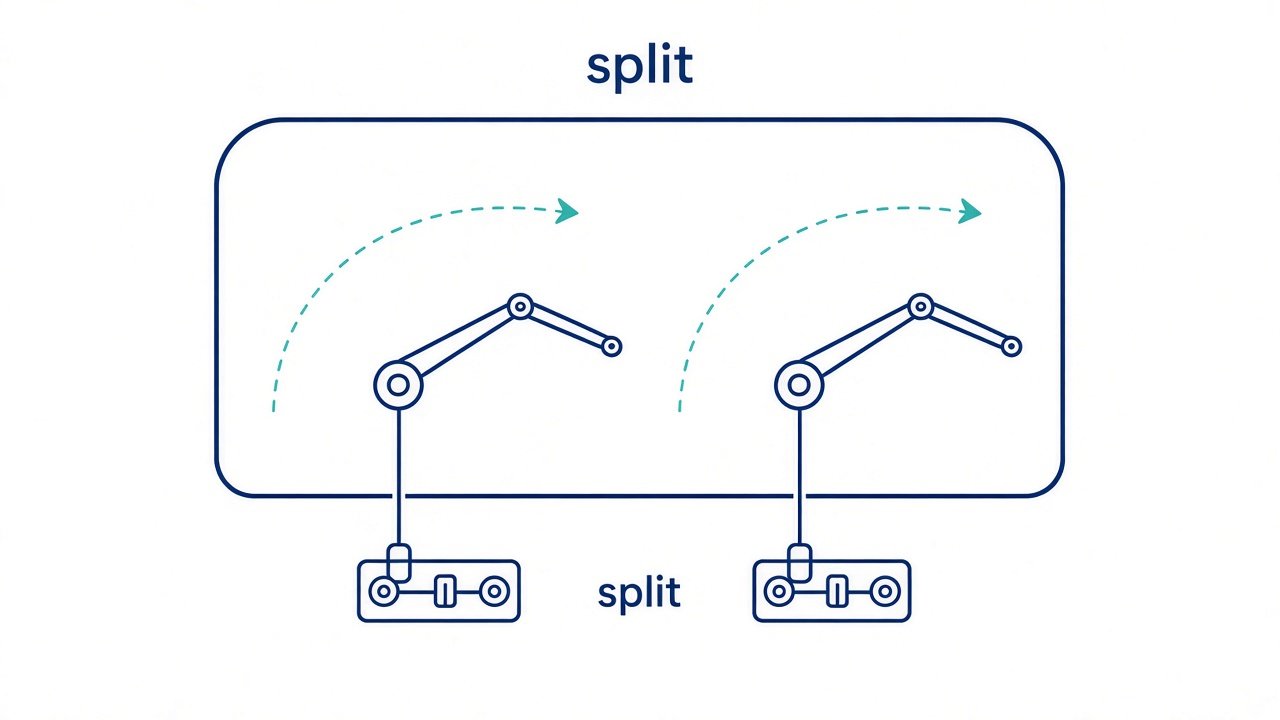
The arms still travel in the same direction, but each side has its own linkage module instead of one continuous bar.
From outside the glass, split parallel can look identical to an integral pair: both blades move the same way. The difference is under the cowl.
Two smaller modules can fit a crowded dashboard, a stepped body, or a vehicle that must ship the left and right sides separately.
The cost of that flexibility is extra parts and two interfaces to seal, time and inspect. Do not treat an integral photo and a split photo as interchangeable without checking the mounting side.
One-drive-one
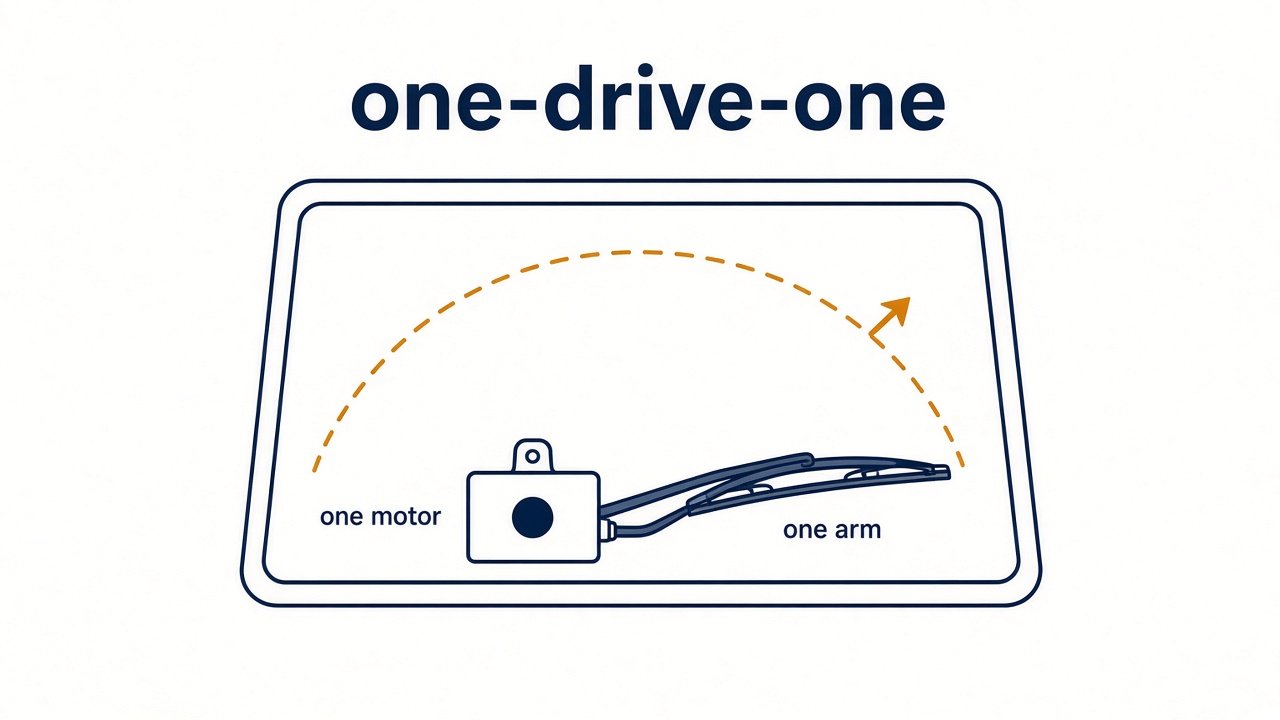
One motor drives one arm across a single wiped area.
This is the usual starting point for a construction cab, a single-pane utility vehicle, or any windshield that is really one defined glass rather than a wide bus screen.
On a wide coach glass, two independent one-drive-one units are not the same thing as a designed opposing or parallel pair. They have no shared timing, so park position and any centre gap must be checked as two separate systems.
Fewer parts per pane is the strength. Limited coverage on a wide screen is the limit. Construction-cab assemblies are listed on https://www.leiliautoparts.com/engineering-vehicle-windshieldwiper-system/ .
How buyers name the same layouts
| You may hear | What it usually means | Closest layout family |
|---|---|---|
| Pantograph or parallel-motion | Extra arm links keep the blade more parallel to a tall edge | Often vertical opposing. Confirm pivots; it is not one SKU. |
| Pendulum or radial | The arm fans in an arc about a single pivot | Common on overlapping opposing and on many parallel pairs |
| Opposed, clap or butterfly | Two arms sweep toward the centre | Overlapping opposing or vertical opposing |
| Tandem, parallel or same-direction | Both arms travel in the same rotational sense | Integral parallel or split parallel |
| Split linkage | The mechanism is divided into modules | Usually split parallel; confirm it is not a split upright form |
| Single-arm or independent drive | One motor drives one blade | One-drive-one |
Translate the buyer’s words into motion before you compare quotations. These are terminology matches, not OE cross-references, and they do not make two similar-looking assemblies interchangeable.
Pantograph is an arm geometry, not a fifth layout of its own. It often appears on vertical plans.
Layout comparison: applications, coverage, space and service checks
Read the coverage column as a set of conditions, not as a ranking. A layout gives better coverage only for a stated glass shape, sweep path and mounting position.
| Layout | Typical applications | Glass & sweep coverage | Installation space | Verify for service |
|---|---|---|---|---|
| Overlapping opposing | Wide, fairly upright bus and coach windshields; a usual first review for an 8 m city bus and for many 12 m coaches that are wide rather than unusually tall | Better centre coverage when the glass is much wider than it is tall and two opposed pendulum arcs would otherwise leave a dry triangle in the driver’s forward view. Applies when parked arms mirror from the two lower corners and the required sweep meets in the middle. Not the better choice on a tall, relatively narrow screen whose dry strips sit along the A-pillars or upper corners. | Room for a two-arm opposed linkage timed so the arms do not collide at centre; the cowl must accept both pivot pockets and the drive package | Pivot-to-pivot distance; park angle and trough clearance; overlap and wipe pattern on the drawing; motor pocket; 12 V or 24 V; arm and blade interfaces; washer-jet aim |
| Vertical opposing | Tall bus or coach glass; screens where a pendulum blade would leave dry strips along an A-pillar or the upper corners | Better edge and upper-corner coverage on a tall glass, or when the blade must stay more parallel to a vertical edge through the stroke, usually with a pantograph or parallel-motion arm. Not automatically better on a wide, low screen whose main risk is a centre dry patch. | Extra arm links need clearance through the stroke; two opposed upright pivots and their motor package | Arm type, pendulum versus pantograph; pivot positions; blade attitude through the stroke; park position; motor size after the sweep plan exists; voltage; interfaces |
| Integral parallel | Narrower windshields, or vehicles already packaged for same-direction tandem sweep | Suitable when both blades park on the same side and still cover the required view without a centre dry triangle. Weaker centre coverage on a very wide screen where same-direction arcs miss the driver’s forward view; review overlapping instead. | One continuous linkage bar between the two pivots; simpler when the cowl can accept a single module | Pivot span; that the bar is one continuous piece, not two housings; park side and trough; gap or overlap between blades; motor pocket; voltage; interfaces |
| Split parallel | Crowded dashboard, stepped body, or left and right sides packed separately, while same-direction sweep is still required | Same sweep family as integral parallel. Coverage follows the same-direction geometry, not the split packaging. Do not assume coverage improves just because the linkage is split. | Two smaller modules; useful when one long bar cannot be routed through the available space | Two housings and seals; timing of both sides; matching left and right mates; pivot positions; voltage; interfaces. Do not interchange with an integral bar from a windshield photo alone. |
| One-drive-one | Construction cabs and other single-pane glass; one defined wiped area | Appropriate when there is one pane and one wiped area. Two independent units on a wide coach glass are not a timed pair and do not automatically give better coverage than a designed opposed or parallel system. | One motor and one arm per pane; the smallest package per pane | Single pivot and motor pocket; sweep angle; park position; blade length; voltage; washer capacity on dusty or muddy duty; whether a second pane is a separate system |
Coverage, service life and any claim that a layout fits a named vehicle type must be confirmed against the project drawing and the test conditions that apply to that order.
Typical application scenarios
These are typical starting points, not named customer projects. Always re-check the actual glass and mounting space.
Typical 8 m city bus
Frequent stops, a wide and fairly upright windshield, and wet-weather duty in urban traffic. Overlapping opposing is the usual first review, because the driver’s forward view sits in the centre of a wide screen. Check that the overlap covers that view and that parked arms clear the wiper trough.
Typical 12 m coach
Larger glass and higher cruise speed. Start with overlapping opposing if the screen is wide and not unusually tall. If the glass is tall and a pendulum blade would leave dry strips along the A-pillars or upper corners, review vertical opposing, often with pantograph-style arms. Blade length and motor load rise with glass area, so size them after the sweep plan, not before.
Typical construction cab
An excavator, loader or similar cab usually has one defined pane, plus mud, dust and vibration. One-drive-one, or a single upright assembly, is the usual starting point. Pair it with enough washer capacity. Dry wiping abrasive dirt wears the blade and overloads the motor. If the cab has two separate panes, treat each as its own one-drive-one decision.
A low-floor city bus and a high-deck coach of similar length can still need different layouts. Vehicle length alone does not choose the system.
Fitment evidence from the field
The diagrams below are LEILI engineering sweep and layout drawings, authorized for use in this fitment guide. They show how common bus layouts package the motor, linkage and arms, and how the blades sweep across the glass. They are teaching and selection references, not a named customer case and not a third-party laboratory report.
On the drawings, the mark a (or α) is the sweep-angle symbol, and 0Y / OY is the vehicle centreline. Final sweep angle, park position, wipe coverage and mounting dimensions for any order are confirmed on the project drawing and, where needed, a wipe test.


An anonymized fitment review
A typical commercial-windshield review starts with the file the buyer can already collect, not with a vehicle brand name.
Customers usually provide the vehicle type and, if known, the model; any existing part numbers still visible on the motor, arm or linkage; installation dimensions that can be measured on the vehicle, such as glass width and height, pivot-to-pivot distance, motor pocket and park trough; field photos of the full windshield taken square-on and of the mechanism from the mounting side, with a tape measure in the frame; the system voltage; and whether they need a complete system or service parts.
Engineering then checks those inputs against the wiped area the driver needs and the space that actually exists: glass geometry; parked-arm direction, opposed or same-direction; whether the linkage is one continuous bar or two modules; pivot positions, motor space and arm or blade interfaces; and whether the proposed motion would leave a dry triangle in the forward view or risk a collision at centre. Layout drawings such as the four above are used to explain the candidate family; they do not replace measured interfaces on the vehicle.
The layout family is selected against those interfaces and written onto a project drawing. Where the risk of a dry patch or interference is high, a sample wipe on the actual glass or a representative test glass is used before production release. Wipe coverage, service life, application to a named vehicle type, and any regulatory marking are confirmed against that drawing and the test conditions that apply to the order. They are not inferred from a catalogue photograph or from a teaching sweep diagram alone. A reviewer who knows the product should check those statements before a quotation or publication goes out.
The public pages below describe the manufacturer’s own layout families and matching sequence. They are reference links, not independent laboratory reports.
- Five layout families on the company page: https://www.leiliautoparts.com/company/
- Assembly matching process: https://www.leiliautoparts.com/how-to-choose-a-wiper-assembly-a-complete-matching-process/
Quick-Check: which layout fits this vehicle?
Use this as a first-pass filter when you have the vehicle, a clear photo, or both. It does not replace a dimensioned drawing or a wipe test.
Read the glass, not the model badge
Is the windshield much wider than it is tall, or tall and relatively narrow? Wide and low points toward overlapping or parallel. Tall points toward vertical or pantograph-style arms.Look at the parked arms
Do they mirror each other from the two bottom corners (opposed), or do both lie the same way (parallel / tandem)? A single arm on a single pane points to one-drive-one.Watch the motion if it is safe to do so
In light rain, or by comparing dirt arcs already on the glass, do the blades move toward each other or in the same direction? Existing wear marks on a parked bus are often enough.Check under the cowl when you can see it
One continuous bar or stamping between the two pivots is integral. A gap and two smaller housings is split. Same-direction blades can hide this difference from outside the glass.Count the motors you can see
One shared drive usually means a linked pair. One motor per arm may be two one-drive-one units or a split package—confirm by whether a linkage still joins the pivots.Match the job to a starting layout
Urban wide screen: overlapping. Tall coach screen: vertical. Compact same-direction pair: integral parallel. Crowded or split cowl: split parallel. Single construction pane: one-drive-one.Stop before you tool or buy in volume
Overlay two paper arcs on a windshield photo to preview a dry patch. Then confirm pivot-to-pivot distance, park trough, motor pocket and a sample wipe on the drawing or a test glass.
This checklist is a starting filter. The final layout is the one that meets the wipe pattern, park position and mounting constraints on the drawing.
Seven specification mistakes to avoid
- Ordering by vehicle brand or length. An 8 m city bus is a scenario, not a part number. Glass curve and pivot pockets decide the layout.
- Treating look-alike photos as interchangeable. A catalogue image does not publish the overlap width, park angle or pivot span.
- Choosing motor wattage before the sweep plan. Wattage follows blade length, arm type, glass curve and required frequency.
- Assuming pantograph equals one SKU. It describes how the blade stays parallel, not a single arm length or finish.
- Ignoring park position and interference. An arm that parks in the sight line, or two arms that meet too late at the centre, fails in service even if the layout name is correct.
- Mixing integral and split packages. They can look the same from outside the glass and still use different body holes, harnesses and service kits.
- Using a catalogue illustration as a production spec. Illustration dimensions are starting references. Production uses the approved drawing.
What to send for a layout review
A usable enquiry file is usually enough for a first technical comment. You do not need a finished OEM drawing on day one.
- Vehicle type or model.
- Existing part numbers, if any remain on the motor, arm, linkage or a previous quotation.
- Installation dimensions you can measure: glass width and height, and any pivot span, motor pocket or park trough.
- Field photos: the full windshield taken square-on, and the mechanism from the mounting side with a tape measure in the frame.
- System voltage, commonly 12 V or 24 V on commercial vehicles.
- Whether you need a complete system or service parts.
- Any wipe-pattern or park-position requirement from the body builder.
If you cannot remove a panel, the exterior photo plus the dirt arcs already on the glass still help a first review.
常见问题解答
How do I know if I need an overlapping layout?
Display a square-on photo of the windshield and sketch two arcs from the lower corners. If they leave a dry triangle in the driver’s forward view, you likely need centre overlap—or much longer blades, which then create their own park and load problems. If the two arcs already cross in that view, overlapping is probably the right family. You still set the overlap width on a drawing.
How can I tell a pantograph layout from a simple vertical arm?
Watch the blade, not the name. A pendulum arm fans from one pivot; the blade angle changes through the stroke. A pantograph or parallel-motion arm uses extra links so the rubber stays roughly parallel to a tall edge. If you can see a second link running beside the main arm, you are usually looking at pantograph geometry.
Can I change the layout on an existing bus?
Measure the pivot-to-pivot distance, the motor pocket and the park trough. If the new layout needs different pivot locations, the cowl or body usually has to change. If those interfaces match, you may only be changing arms, blades and the linkage on the same mounting points. Do not assume a new layout drops onto the old holes because the glass looks similar.
How do I tell integral parallel from split parallel without a drawing?
From the mounting side, look between the two pivots. One continuous tube or stamping is integral. A clear gap and two housings is split. From outside the glass, same-direction travel can look identical, so do not decide from a windshield photo alone.
What photos and measurements should I send with an RFQ?
Send the vehicle type or model, any existing part numbers, the installation dimensions you can measure, and field photos of the glass and the mounting side. Add voltage, whether you need a complete system or parts, and a note if a camera, rain sensor or destination sign sits near the park area.
When does a construction cab need one-drive-one?
If you see one wiped pane and one motor-and-arm, start with one-drive-one. If you see two independent motors with no connecting linkage, you likely have two single systems, not a linked pair. Dirt load and washer capacity matter as much as the layout name on these cabs.
Are supplier layout codes the same as OE part numbers?
No. Layout codes describe a form—how the arms move—not an OE cross-reference. Two suppliers can use similar photos and different interfaces. Match by drawing, pivot span and wipe pattern, not by a code that happens to look similar.
摘要
Five layouts cover most commercial windshields: overlapping opposing, vertical opposing, integral parallel, split parallel and one-drive-one.
The useful question is not which name is premium. It is how the arms must move so this glass is wiped where the driver looks, then parks clear of the sight line.
Choose by glass geometry, park direction, installation space, the coverage the driver needs, and how the motor and linkage share the load. Better coverage is always a conditional claim.
A photo, the parked-arm direction, any dirt arcs on the glass and a look at the linkage will get you to a starting family. A drawing and, where the risk is high, a sample wipe test lock the specification.
Request a Fitment Check
If you need a layout reviewed rather than a motor wattage quoted in isolation, request a fitment check.
Send the vehicle type or model, any existing part numbers, the installation dimensions you can measure, and field photos of the windshield and the mounting side. Voltage and whether you need a complete system or service parts help the first reply.
A fitment check compares that package with the sweep plan and the mounting interfaces. It can indicate which layout family should be reviewed next, and what still has to be confirmed on a drawing. It does not replace an approved production drawing, a wipe test where one is needed, or a market-specific regulatory approval.
Request the check through https://www.leiliautoparts.com/contact/ . The matching sequence on https://www.leiliautoparts.com/how-to-choose-a-wiper-assembly-a-complete-matching-process/ lists the same kind of file.
Resources and catalogue examples
The links below are catalogue illustrations and manufacturer process pages. A layout code is not a complete assembly and not an OE cross-reference. Confirm dimensions, sweep, voltage and supplied parts on the project drawing.
Do not assign an integral versus split label from a parallel catalogue code alone. Review the mounting-side photograph. One single-arm listing may also show a split upright form in its image files; review the photo rather than translating the label.
- Request a fitment check
- Wiper assemblies
- 雨刷电机
- Wiper arms
- Wiper linkages
- Bus and coach wiper systems
- Engineering vehicle systems
- Assembly matching process
- Five layout series overview
- Overlapping examples (KG-001 to KG-005)
- Vertical examples (KG-006 and related references)
- Parallel / ordered examples (KG-007, KG-008)
- Single-arm example (KG-009)
- Engineering / one-drive-one examples (KG-012)
- Published warranty terms
Published commercial terms on that warranty page: wiper blades are consumable wear parts and have no warranty. Other components are covered for one year or 2,000 operating hours from delivery, whichever the published statement applies. Confirm the written terms that apply to your order.